
Checking In Every Hour Wears Down Trust
A hypothetical: "Keng" owns a ten-person web agency. After the office rent went up, he let the team work from home. The first week he felt fine. In the second week he opened the chat, wondered why everyone had gone quiet, and began messaging people one by one every two hours: "How far along are you?"
The team started replying faster, but they worked in short bursts just so they would have something to report. Some left their screens on while they went to pick up their kids, afraid that silence would be read as disappearing. Keng got more messages but no deeper work, and the Friday meeting turned tense without anyone saying why.
His concern was real. Client work has deadlines. He simply picked the wrong tool for that concern.
The Gap Called Productivity Paranoia
Microsoft's Work Trend Index report from September 2022 surveyed 20,000 people in 11 countries and found what it calls "productivity paranoia." 87% of employees said they were productive, while 85% of leaders said the shift to hybrid work made it hard to be confident that employees were working at full capacity. Only 12% of leaders were fully confident that their team was productive.
Hybrid managers also reported less visibility into their team's work: 54%, compared with 38% of managers working in the office. That gap pushes some companies toward monitoring activity on employees' computers instead of improving how work is made visible.
A randomized experiment published in Nature in 2024, covering 1,612 employees at Trip.com, found that a hybrid schedule with two days a week at home did not worsen performance ratings over the following two years, and found no difference in promotions, while attrition fell by about a third. Policy details are in Hybrid Work. This is a single-company study, so it is not a guarantee for every business, but it removes the assumption that "I can't see you, so the work must be slipping" as the default.
Harvard Business Review published an article in July 2020 titled Remote Managers Are Having Trust Issues. Its figures sit in a part that can't be read in full from the public page, so we can cite it only qualitatively: trust is a challenge for managers of remote teams. We shouldn't add statistics we haven't been able to read.
What to Measure Instead of Online Time
Write Down the Week's Results Where Everyone Can See Them
Give each person three to five lines that the whole team can open: what they will deliver this week, where it stands now, and what is blocking it. Update in rounds, not every hour. The manager reads this first, before sending a message.
If the list is empty for a whole week, then have a conversation. An empty report is the signal, not a green dot on a mouse-tracking program.
Schedule Work Reviews Around Delivery Points, Not the Clock
Set the points at which work should be ready to look at, such as a first draft on Wednesday and the final version on Friday. Between those points, let people work without being scanned. If a delivery point is empty, step in to help with whatever is blocking it, rather than increasing how often you check in.
How to set the rhythm for one-on-ones is covered in Managing a Remote Team.
Let People Set Their Own Status
A few statuses are enough, such as available, open to being approached, focusing, and in a meeting. People set and change them themselves. A manager uses them to avoid interrupting someone who is thinking, not as a time card.
If the company starts wanting a report of how many minutes someone was online, stop and go back to the task list. Online minutes can be bought by leaving a window open.
Don't Install Monitoring Tools to Ease Your Anxiety
Screenshots, click counting and always-on cameras make people work for the monitor, not for the client. They also add privacy risk for both employees and any clients who happen to be on screen. That topic is covered in Data Security When Working From Home.
Transparency Is Not Surveillance
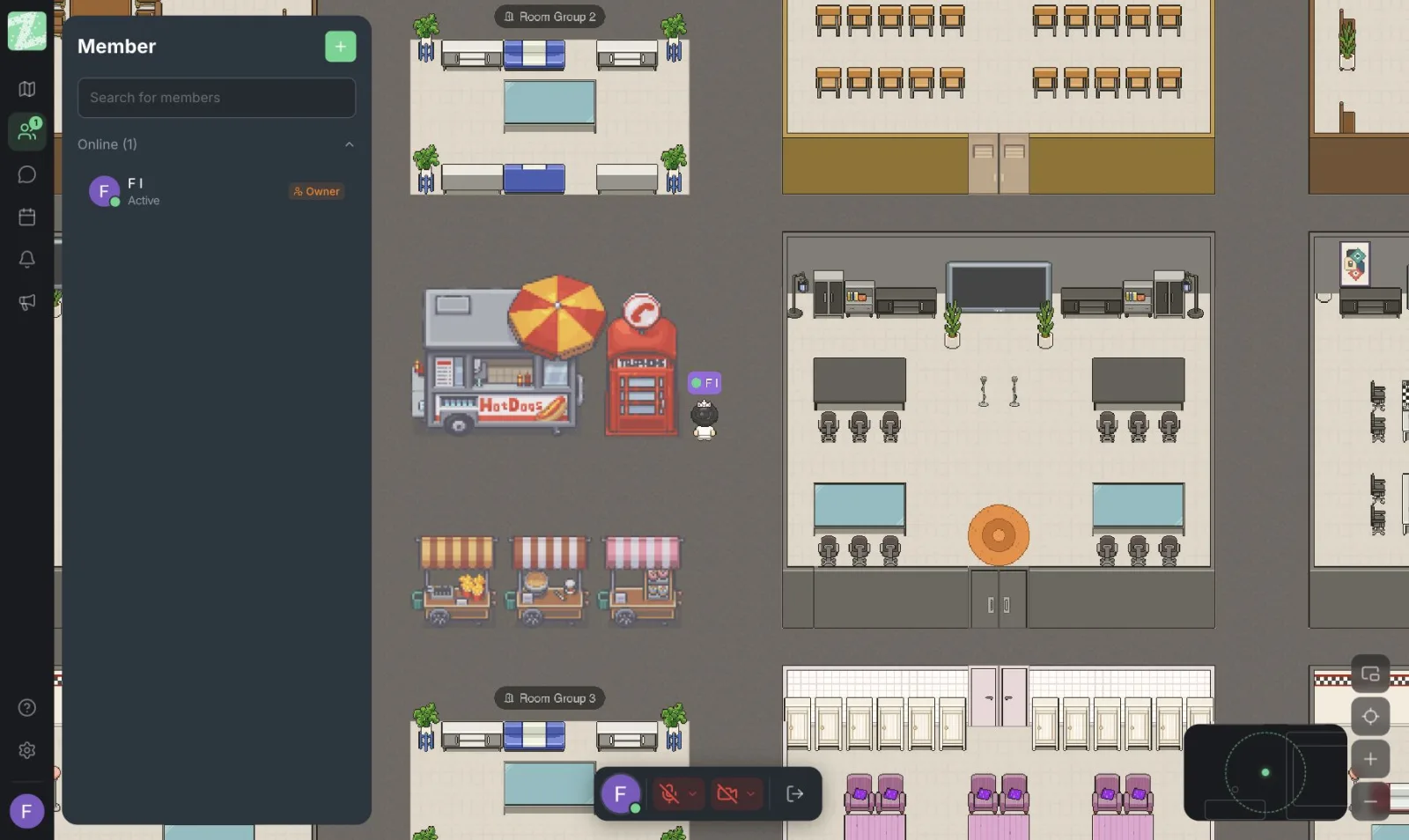
Zyra World shows statuses that the team sets themselves, such as available, focusing or in a meeting, in a shared space where you can walk over and ask when the other person is ready. Zyra does not record audio, video or screen sharing. Core data is stored in Singapore, and user data is not sold.
Don't read this paragraph as saying Zyra is an employee-tracking program. It isn't. The point is to let a team see one another the way you would when walking past a desk, not to let a manager replay who did what, minute by minute. Space and invitation features are on the Features page, and the broader idea is in Online Office.
Google Meet Works Fine for Reviews With an Agenda
Review sessions at specific points still work well on Google Meet. There is a set time, there is a screen, and people outside the team can join when you need to go over work with a client. Zyra is not meant to replace that review.
Between two delivery points, Meet shouldn't turn into an hourly mini-meeting to ask how far along someone is. A status in an office that stays open, plus three written lines a week, do that job more lightly. Use the two together.
A Weekly Update Format That Works in Practice
The format people will actually fill in is one that takes two minutes to read, both for the writer and for the manager. Try these four lines every Thursday. It doesn't need to be a slide deck.
- Delivered: work that left your hands this week, named by deliverable, not by hours.
- In progress: work still with you, and which review point it will reach.
- Blocked: what is waiting on someone else, or what you can't decide alone. This line matters most. If it's empty every week, it may mean nothing is in the way, or it may mean people don't dare write it down. Use the one-on-one to ask follow-up questions.
- Need from the manager: an approval, an introduction to someone, or time set aside. Not the word "nothing."
The manager replies in the same place by the next day, even if only to say they have seen it and will clear the blocked item on Monday. If the manager goes silent after the team writes, nobody writes next round, and you will drift back to messaging every hour.
Don't add columns for clock-in time, clock-out time or number of messages answered. That turns the form back into surveillance. If the work in items one and two isn't moving while item three is empty, talk about that specific piece of work with that person.
Use this for two weeks before deciding whether you need a new tool. Many teams find that worry drops once they can see how work is moving, even though they still can't see who is sitting at a screen.
If you are still sending repeat check-ins after two weeks, look at whether the form lives in a different place from the work. The update field should sit close to the pieces of work it mentions, not in a file that has to be opened separately. The more app-switching it takes, the fewer people fill it in, and the manager goes back to asking in chat.
This Week, Drop One Kind of Check-In
Pick one channel where you keep chasing people, such as an afternoon chat asking for progress, and replace it with a three-line list updated once a day. Tell the team plainly that you are making the change because you want to stop making everyone prove they are online.
Open a space in your browser where statuses are self-set with Zyra, which includes video in proximity chat. Teams of up to 25 can start for free.
Start Zyra free for teams of up to 25
Frequently Asked Questions
How can I track WFH employees' work without micromanaging?
Have one place that shows where work stands, with agreed delivery points and statuses that people set themselves. Then talk when a delivery point is empty or something is blocking progress, not every time the chat goes quiet.
Will screen-capture software put my mind at ease?
It shows activity on a computer. It doesn't show whether the work is getting better, and it wears down trust. Microsoft's 2022 report already shows that most employees say they are productive while most leaders struggle to feel confident. Screen capture doesn't close that gap.
Can online status be used as a time clock?
It shouldn't be. Use it to know whether to message someone now or wait. If you need working hours for labor-law purposes, use a time-tracking system designed for that, not a green dot in a chat.
What should I do if a team member doesn't post the three-line update?
Ask whether the channel is hard to open or whether they fear being judged by what they write, then make it shorter. If it stays empty over time, talk about that piece of work, rather than adding monitoring tools.
Does Zyra record conversations for managers to review later?
No. Audio, video and screen sharing are not recorded. A status shows what people on the team see at that moment, not an archive to replay.
Try Zyra with your team
Free for up to 25 members. It runs in your browser, so there is nothing to install.