
A Day of Notification Sounds, and Nobody Asking How You Are
A hypothetical: "Fai" moved to working from her condo after her team gave up its assigned desks. Her work is delivered in full, and her manager praises her in the weekly meeting. But from Monday to Thursday she talks to no one outside a thirty-minute meeting. Nobody asks how her day is going. There are only messages handing out tasks.
On Friday evening she realizes she hasn't laughed all week. She isn't ill, and she doesn't hate her job. She just has no moments of being a person on the team, other than the person who sends files.
This article is about loneliness in the rhythm of working from home. It is not a diagnosis, and it doesn't suggest that any tool treats the condition. If loneliness is heavy enough to affect your sleep or your motivation to keep working, talking to someone you trust or to a health professional is a separate matter from a team's ground rules.
Loneliness Isn't a Private Problem of People Who "Can't Adapt"
On 30 June 2025, the World Health Organization published news that 1 in 6 people worldwide are affected by loneliness, and that loneliness is linked to more than 871,000 deaths a year. This is a report on social connection among the global population, not a survey of people working from home in Thailand, so it shouldn't be read as saying that working from home causes that number. It does put the scale of loneliness in a bigger picture than one person's mood.
Among remote workers specifically, Buffer's State of Remote Work 2023, which surveyed 3,000 people worldwide, found that 23% named loneliness as one of their difficulties. It ranks next to the feeling of being at home so often that there is no reason to leave the house. The two go together: nowhere to go, and nobody to reach out to without scheduling.
GitLab writes that informal communication has to be organized on purpose, and has new hires schedule at least five coffee chats during onboarding. A company that has run remotely for a long time doesn't assume relationships will grow by themselves out of a chat tool.
When the working day has no edges, loneliness can mix with fatigue in another way. How to manage your time and stop work on time is covered in Working From Home Productively.
Signs a Team Can Notice Without Spying
These signs are not a test. Notice them to start a conversation, not to attach a label.
- Someone who used to start conversations in the channel now replies only when tagged on work
- They turn their camera on less and less, and skip one-on-one activities, though they never turn down work
- They keep working late with no delivery reason, because no one is around to talk to during the day, so work has become the company
- A newcomer who joined more than a month ago still talks to no more than two people
A manager should ask directly in a one-on-one who they talked with this week about something other than work, then listen without rushing to suggest a game.
What a Team Can Do in an Ordinary Week
Give People a Place to Reach Out Without Scheduling
Loneliness in working from home is often not about lacking friends in life. It is about lacking a two-minute moment during the working day. That moment dies when every conversation needs a link and a slot in the calendar.
Set aside a corner or a time when people can walk over and chat about something other than work, such as before 10 a.m. and after 4 p.m., without calling it an activity.
Short Pairings Instead of a Big Party
A big room where everyone has their camera off doesn't reduce loneliness, because nobody has really talked to anyone. Use twenty-minute coffee chats that rotate pairs within the team. Ideas are listed in Online Team Building Activities.
Don't Make Newcomers Wait Until They Feel Brave
Someone who doesn't know anyone won't reach out first, especially in a culture that values not imposing on others. Have a buddy reach out first for the first three times, without waiting for the other person to come in.
Tell the Silence of Focus From the Silence of Loneliness
Some people turn off notifications because they are concentrating, which is good. Some go quiet because they have nowhere to go. The difference is whether they still have a way back to the team when they want to talk. If that way is to request a meeting, which takes two days, loneliness will win first.
Feel That Someone Is There, Without Keeping the Camera On All Day
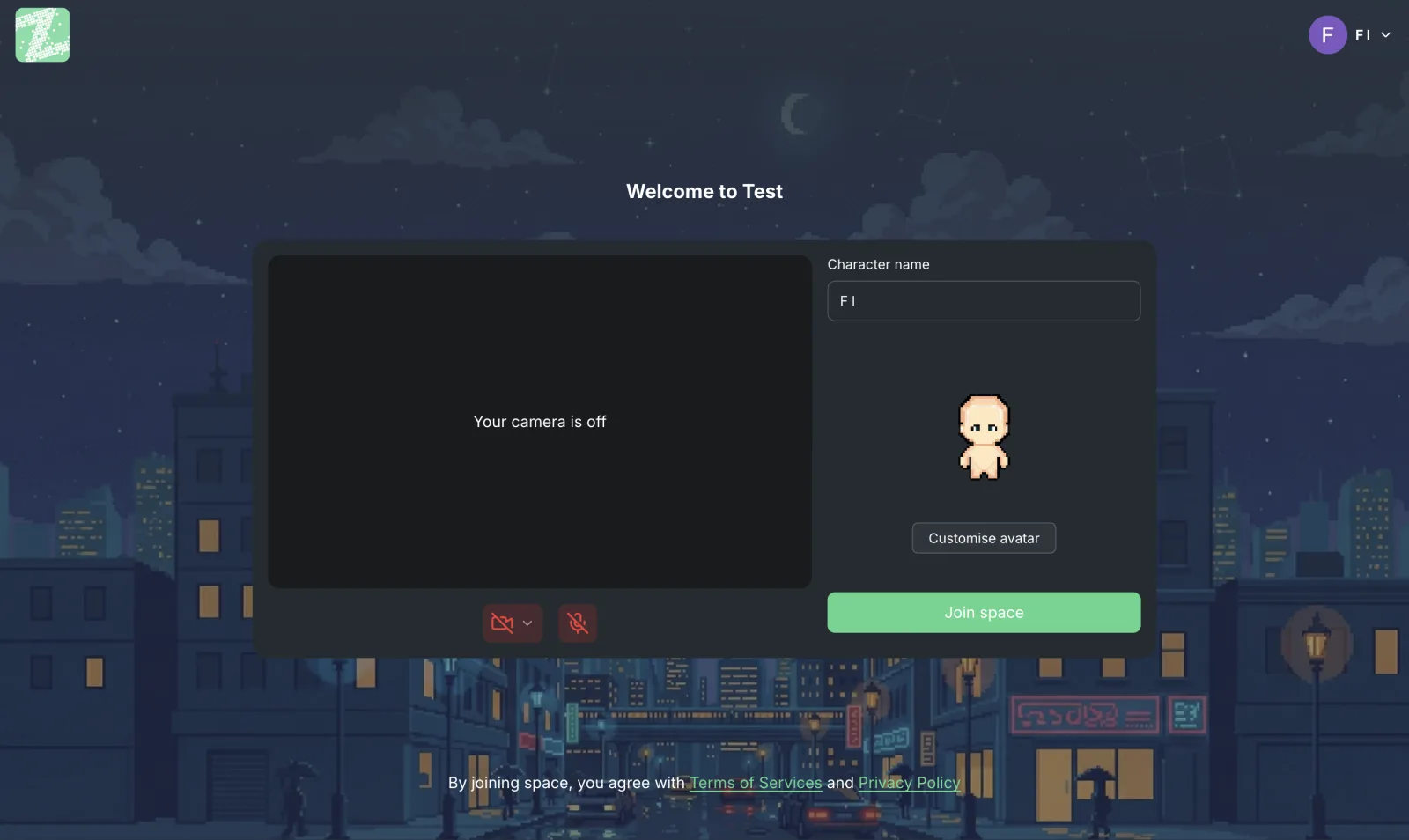
Zyra World lets you see your teammates in the same office, even on days with no meetings. An avatar sitting in another corner is a sign you aren't working alone. You can say a quick hello by walking closer, when the other person hasn't marked themselves as focusing, and there are break corners for casual conversation with no agenda.
This is not a treatment, and it isn't a promise that loneliness will go away. It is a place where two-minute moments can happen more often. It works in the browser with nothing to install. For the overview, read Online Office.
Google Meet Gives Scheduled Conversation; What's Missing Is the Time in Between
Google Meet lets a team see each other's faces in meetings that have an end. For many people, that meeting is the only time in the day they hear a real voice. Fatigue from long stretches with the camera on is a separate issue, and loneliness shouldn't be fixed by adding meetings until the calendar is full.
Zyra is used alongside Meet as an office that stays open between meetings. People can reach out without every conversation having to be a single video call. Meet remains for meetings that need an agenda.
What You Can Do Yourself, Without Waiting for the Company to Organize Something
A team has a duty to arrange these moments, but a lonely person shouldn't sit waiting for next quarter either. There are a few things you can do in an ordinary week without revealing your whole life.
Set up a walk or a coffee with a real person once a week, even if they aren't a coworker. Buffer's report points to one of the top difficulties for remote workers being staying home so much that there is no reason to go out. Having a plan to leave the house is different from a work appointment, but it keeps the day from ending at the same desk.
At work, pick one person you have worked with on a project and invite them to a twenty-minute coffee chat yourself. Don't always wait for your manager to pair you up. The person who reaches out first often gets a partner sooner, because the other side is also being polite and hesitant.
Separate the stretches when you are deliberately quiet to focus from the stretches when you are sitting quietly because you don't know whom to go to. Write on your status which time is focus and which time is open to being approached. If the whole day is the same kind of silence, the team can't tell, and you won't get approached.
If several weeks pass and you still feel so empty that you don't want to turn on your computer in the morning, tell your manager or someone you trust in a direct sentence. Don't wait for it to become a crisis. And if it spreads to your sleep or to feelings of hopelessness, talk to a health professional. Chat ground rules can't replace that.
Start With One Question in This Round of One-on-Ones
Ask each person how many times last week they talked with a teammate about something other than work. If several answer zero, set up coffee chat pairs for the next two weeks before you buy a big activity.
If you want a space where you can see each other all day without scheduling every time, you can try Zyra for teams of up to 25 members.
Start Zyra free for teams of up to 25
Frequently Asked Questions
Does feeling lonely working from home mean remote work isn't for me?
Not necessarily. Loneliness is a sign that the rhythm of meeting people has gone missing, not a verdict that someone can't work from home. A team that creates a place to reach out without scheduling can often narrow this gap without calling everyone back to the office all week.
Should we require cameras on to prevent loneliness?
No. Keeping the camera on all day is tiring and doesn't mean people have actually talked. A short one-to-one conversation helps more than being looked at in a frame all day.
What should a manager do when a team member says they feel lonely?
Listen all the way through, then set up something concrete, such as a conversation partner over the next two weeks or a corner where people can walk over and say hello. Don't answer by telling them to adjust their attitude, and don't act as if a tool alone is responsible.
Do big events help?
Occasionally, but loneliness usually lives in the five ordinary weekdays. If there are only quarterly parties, the gaps in between are still empty.
Can this article replace health advice?
No. It is about how a team arranges work and being together. If distress affects your sleep or your daily life, talking to a professional is a better path than looking for more team rules.
Try Zyra with your team
Free for up to 25 members. It runs in your browser, so there is nothing to install.