
A First Day With Only a Link, and a Resignation in Month Three
Picture "Nont," who starts as a designer at a 15-person company on a day when the whole team is working from home. HR sends a Google Meet link at 9 a.m., talks for forty-five minutes about benefits, then sends a ten-page PDF and three system logins in a private chat. After that there is no meeting until evening.
He does not know who to ask about the brand fonts. He does not know who is free, and he does not want to message his manager for fear of interrupting. His teammates assume someone else is looking after him. By the end of the second month he still knows no more than four people. By the end of the third month he resigns, saying, "The work was fine, but I never felt like I was part of the team."
This happens again and again in teams that are good at their work but have no structure for the first thirty days. When people do not sit at neighboring desks, a welcome does not happen by itself.
Why Onboarding Decides Whether People Stay
Gallup found that only 12% of employees strongly agree that their organization does a great job of onboarding new employees. This figure comes from Gallup's work and is not identified as a sample from Thailand, but the gap it points to matches the day Nont had: a first day that ends without any connection to the real work.
SHRM cites a 2007 Wynhurst Group study saying that new employees who went through a structured onboarding program were 58% more likely to still be with the company after three years. This is 2007 data, so it is old evidence and should not be read as this year's market rate. But the direction still fits what teams see in practice: a clear checklist and a named owner help new people stay more than sending files and hoping they will figure things out.
GitLab, which hires remotely across the whole company, uses an onboarding issue as a standard task list, with a buddy and coffee chats. It states that every new joiner should schedule at least five coffee chats during onboarding. For approaches to building relationships, see online team building activities. For the loneliness of people who do not yet know anyone, see Working From Home and Feeling Lonely.
The 30-Day Checklist
Use it as a list, not a ritual to be completed for the photos. Each item should have a named owner, not "HR" as a whole.
Before Day One
Send a welcome email that gives the start time, the single contact for day one, and what to prepare. Set up the email account and system access before the morning of the first day, so the new person is not left waiting for passwords while everyone else has already started work.
Assign a buddy: a teammate who is not the direct manager. The buddy's job is to introduce and guide, not to evaluate performance. Write this role so the buddy can read it in half a page.
Prepare the thirty-day task list as a single document where the new person can see their own progress, following the idea of GitLab's onboarding issue. The list should include both tool tasks and people tasks, such as completing five coffee chats within the first month.
Day One
Start with a short meeting that has an agenda, not one long session about the whole company. Thirty to forty-five minutes is enough to cover what the person needs to know today: how the team works, which channel is used for what, and who the buddy is. Then give them time to set up their computer and read documents, with the buddy available to message.
Do not turn day one into six back-to-back meetings. The new person cannot remember the names yet and has not done a first piece of work.
Walk them through the space where the team lives. If the team has an online office, let them see who sits where, instead of sending a list of names in a spreadsheet.
First Week
Give them a small task that can be finished within the week, not a three-month project as the first piece. A small task teaches them where to submit work, who reviews it, and what level of quality is good enough.
Schedule at least one one-on-one with the manager this week. The topic is not evaluation but the questions the new person does not yet dare to ask in the group.
The buddy holds the first coffee chat within the first three days, and the rest are spread across the month. They do not need to be big events. Twenty minutes on something other than work is enough.
Day 30
Sit down with the manager and answer three questions. Which tasks can the person now do without asking? What is still unclear? Who have they gotten to know besides the buddy? If the answer to the third is still zero, treat onboarding as unfinished, even if the HR paperwork is complete.
Keep this list for the next person. Do not rebuild it from memory each time.
Let New People Walk Over and Say Hello, Without Waiting for a Link
Nont did not drift away because the PDF was not detailed enough. He drifted away because he could not see who to walk over to.
Zyra World lets you invite people to a workspace by link or email. A new person opens it in the browser and sees who is where. They can walk their avatar over to say hello when the other person has not set a status of focusing. You can seat the buddy's desk next to theirs, or use a template to build a welcome room for the first week. When someone leaves the team, you can remove their access immediately, without wondering whether they are still in the chat group.
For an overview, see Online Office, and for what this kind of space means for a team, see Virtual Office for Teams. The invitation and space features are on the Feature page.
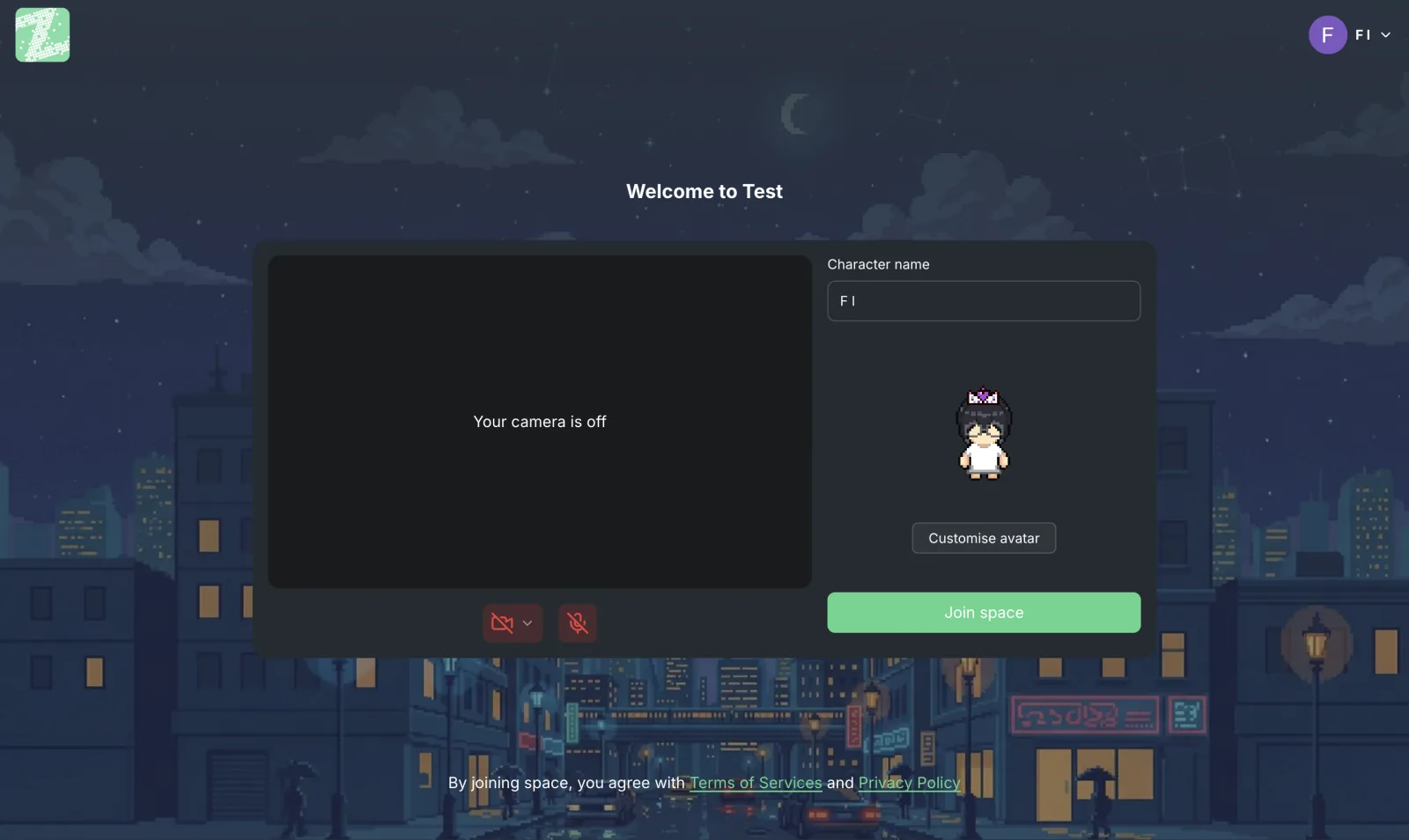
You Can Still Use Google Meet for the Orientation Meeting
Google Meet suits the day-one meeting that has a clear agenda, involves HR, and may include people who have not yet joined the workspace. A scheduled orientation can stay on Meet or on whatever scheduling tool the company already uses with outside people.
Zyra is where the person is after that meeting ends: day two through day thirty, with the buddy nearby and short questions that do not have to wait for the next scheduled meeting. The two work together. You do not have to move the orientation off Meet.
What the Day-One Email and the First Task Should Look Like
The email before day one does not need to be a company handbook. Ten lines are enough. If it is longer, the new person will not finish reading it and will ask the same questions anyway. Include at least these six things.
- The start time, and the one channel where someone will answer on the first morning
- The buddy's name and how to reach them, not "someone will be in touch"
- A link to the thirty-day list document, instead of ten attached copies of a file
- What the person needs to prepare, such as identity documents, if any
- What the company has already prepared, such as email and system access
- The first meeting of the day: how many minutes and about what, not just "let's meet"
The first task should be finishable within four days and have a named reviewer. In a small team, a workable example is to edit a one-page document the team actually uses and send it back in the agreed place, rather than "study the product until you understand it," which gives no way of knowing when it is enough. A task with edges lets the person practice this team's way of handing in work from the first week, and lets the manager see whether the sticking point is the tools, the information or the expectations.
On day three, have the buddy ask four questions without going through the manager. Does the person have all their system access? Do they know where the main files are? Do they know who to message when stuck? Is the next coffee chat scheduled? If any answer is no, fix it that day, without waiting for an end-of-month survey.
Before You Hire the Next Person
Give this checklist to someone who joined the team in the past year and ask which items did not actually exist when they started. Fill those in before you open the next hire. A structure that is written down but has no buddy who knows the role is still the same as a PDF.
You can open a welcome space in Zyra for teams of up to 25 members. It runs in the browser, with nothing to install.
Start using Zyra for free for up to 25 members
Frequently Asked Questions
How many days should online onboarding take?
The first thirty days are a frame you can use to check that the new person has a first task, a buddy, and has talked with people on the team. Some roles take longer before the person can work independently. But if on day thirty they still do not know anyone, the structure is not enough.
Should the buddy be the manager?
They should not be the same person. The manager assigns work and holds the one-on-ones. The buddy is a teammate who answers the questions a new person does not dare to ask the manager. Write this role down clearly so the buddy does not become an evaluator.
Do we need a big welcome event?
Not necessarily. Several short coffee chats do more than one party where everyone keeps their camera off. GitLab uses a minimum of five during onboarding. This is an example from a company that works remotely across the whole organization, not a magic number every company has to copy.
A new hire left before three months. What should we fix first?
First check whether, on day one, they had someone they could message, and whether, in the first week, they had a small task that was completed. If neither was in place, adding more documents will not help.
What should we do about system access on the day someone leaves?
Remove access on the day they leave: email, files and the workspace. Do not wait until the end of the month. Removing it right away is both a security matter and a way of making clear who is still on the team.
Try Zyra with your team
Free for up to 25 members. It runs in your browser, so there is nothing to install.