
You Find Out When the Work Is Already Late
A hypothetical: "Praew" has just become the lead of an eight-person customer service team. Everyone works in a different province. The Monday weekly video call takes thirty minutes, and each person says they are "making progress." She doesn't want to dig deeper, because she is afraid of looking as if she doesn't trust them.
On Thursday, a big client's deliverable is overdue. She only now learns that someone on the team has been stuck for three days waiting on data from another department, but didn't want to call a meeting to ask a single question. Praew isn't careless. What she lacks is a moment that used to happen by itself in the office: walking past a desk and noticing that someone is unusually quiet.
New managers of remote teams often swing between two extremes: checking in every hour, or not asking at all until something is on fire. This article is about the path in between.
The Gap Between "I'm Working" and "I Can Be Confident"
Microsoft's Work Trend Index from September 2022 surveyed 20,000 workers in 11 countries and found what it calls "productivity paranoia." Of employees, 87% said they are productive at work, while 85% of leaders said the shift to hybrid work made it hard to be confident that employees are being productive. Only 12% of leaders said they were fully confident that their team is productive.
Managers of hybrid teams also said they had less visibility into their team's work: 54%, compared with 38% of managers in the office. They were also more likely to say it is hard to trust team members to work at their best (49% compared with 36%).
Harvard Business Review published an article, Remote Managers Are Having Trust Issues, in July 2020. The figures are in the part that can't be read in full from the public page, so it can only be cited qualitatively: a number of remote managers run into trust problems when they can't see their team. Don't use statistics from that article unless you have read the full version.
In its informal communication guide, GitLab writes that informal conversation has to be designed on purpose, because relying on bumping into each other in a physical office doesn't make those conversations happen on their own when a team is in different places. If the manager doesn't create openings for people to come and ask, team members wait until it becomes a crisis.
The policy on which days are office days and which are home days is directly related to this. Read more in Hybrid Work.
What a Manager Can Do Instead of Pinging Every Hour
Separate Seeing the Work From Seeing the Person
Praew's concern is the work, not where a mouse pointer is. Ask what stage a piece of work is at, what is blocking it and who it needs. Don't ask whether someone has been online since what time. Measuring the latter makes people leave an app open without moving the work forward.
How to set up tracking that measures output is in Tracking Work-From-Home Employees Without Micromanaging.
Make One-on-Ones a Regular Rhythm, Not an Exam Room
Hold a short meeting with each person on a cycle they can predict, twenty to thirty minutes. At least half the agenda should come from them. Useful questions are what is stuck, and what the manager is slowing down. No slides needed.
When the rhythm is reliable, people don't hold problems until deadline day, because they know there is a place to put them.
Open Hours When People Can Walk Over and Ask
Besides one-on-ones, set times when team members can reach out without scheduling, such as Tuesday and Thursday afternoons. Write them where people can see them, both on the calendar and in the place the team has open every day. Most problems in remote work don't need a thirty-minute meeting. They need someone who will listen for two minutes.
Write Conclusions for People Who Didn't Hear Them
A conversation that ends in a meeting or a walk-over needs one line in a place the whole team can open. Otherwise, people who are on leave or in another time zone end up working from different memories.
Design Conversations That Aren't About Work
GitLab stresses that trust comes from informal conversation that has to be arranged. A manager doesn't need to be a party host, but should know whether, this month, each person has talked with teammates about something other than work status. If not, don't blame the team for not bonding. Create the opening.
See Status, Then Let Them Walk Up to the Desk
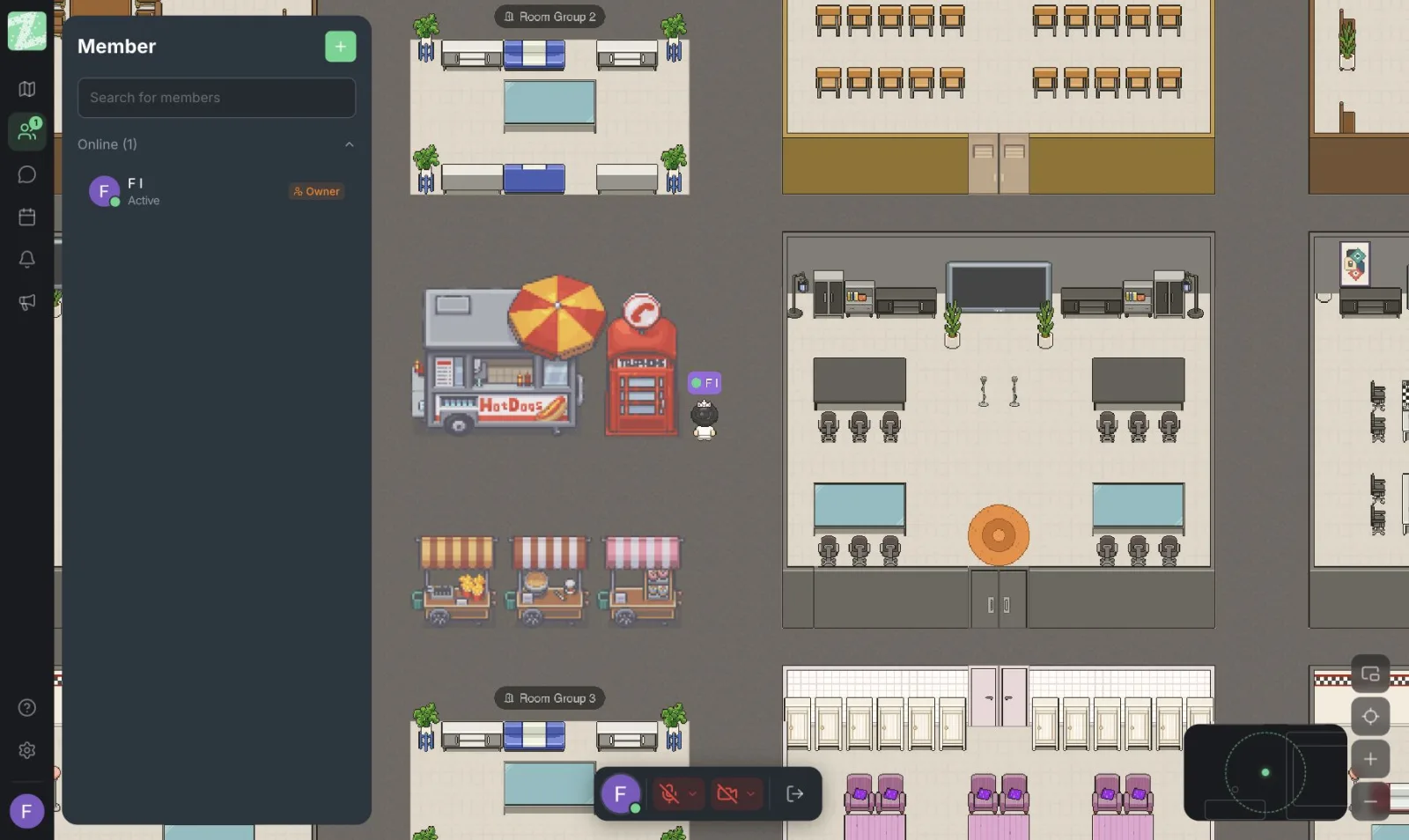
Praew doesn't need to peek at her team's screens. She needs to see who is focusing, who is in a meeting and who is free enough for a short question.
In Zyra World, each person's status lives in the same space. Team members can walk their avatars over to ask, like walking up to the manager's desk, without opening a new meeting every time. A one-on-one that should be private can take place in a private zone, so the sound doesn't spread across the whole office.
This is transparency the team sets for itself, not a tool for timing how long people are online. The overview is in Online Office, and the team context is in Virtual Office for Teams.
Performance Reviews Can Still Be Scheduled on Google Meet
Google Meet suits one-on-ones with a long agenda, quarterly reviews and conversations with people who haven't joined your team's workspace. Use it fully for those.
Zyra fits the stretch between those meetings, when a problem has just begun and is still a two-minute question. If every question has to wait for Monday's Meet, Thursday will go overdue the way it did for Praew. Use an always-open office alongside your meetings. You don't have to choose one.
Questions Worth Asking, and Questions That Make a Team Shut Down
A good question reveals the work. A bad question makes people prepare answers about their time in front of a screen. A manager who has just started leading a remote team can try this set in the first two one-on-ones, then cut the items the team member answers by rote.
Worth asking
- Which piece of work can move on its own, and which is waiting on someone else?
- What is the manager slowing down, especially approvals or unanswered messages?
- Is there anything you'd like help clearing with another team?
- This week, who have you talked with about something other than work status?
Not worth asking as the first thing every morning
- What time did you start today, and how long will you be online?
- Why didn't you read the chat just now when your status is still green?
- Can you send a screenshot to show what you're working on?
The second set measures presence. The first measures how work flows. If team members start answering at length about their schedule but briefly about what's blocking them, treat the rules you've sent as still being the rules of being watched, and change the questions. Don't add more frequency.
Another thing new managers often forget is to tell the team that they, too, are sometimes focusing. If the manager can ping anyone every minute, but team members can't reach the manager because the manager is in meetings all day, the channel flows one way. The trust that Microsoft found hybrid managers feel they have less of won't come back through a form. It comes back when both sides can walk over to each other at announced times.
A New Manager's First Week
Pick one thing this week. Open two walk-over hours, and write up the conclusions of Monday's meeting in a place the whole team can see. Don't add an hourly report form at the same time, because that takes you back to policing.
If you want a space where status and walk-up questions happen without scheduling, you can try Zyra in the browser for teams of up to 25 members.
Start Zyra free for teams of up to 25
Frequently Asked Questions
Do I need to hold a meeting every day to manage a remote team?
No. Whole-team meetings held too often tend to become updates that could be written. What should be regular is a predictable one-on-one, plus a way to ask small things without scheduling.
How can I tell a team member is stuck if they don't say so?
Make it easy and safe to say. People speak up when there are openings to walk over and ask, and when saying "I'm stuck" isn't read as "not working enough." Pinging every hour makes them say less, not more.
How do you build trust when you can't see each other?
With written conclusions, clear deadlines and conversations that aren't only about work status. Microsoft's 2022 report shows the gap between employees who say they are productive and leaders who find it hard to be confident. That gap closes by making the work visible, not the person.
How long should an online one-on-one be?
Twenty to thirty minutes is enough for weekly or biweekly. If you need a full hour every time, there are topics that should have been discussed between meetings rather than saved up for them.
Should we use screen-monitoring software?
This article doesn't recommend using surveillance as a fix for a lack of confidence. Measure the work that is delivered, and let people set their own status. See the principles in the article on tracking work without micromanaging.
Try Zyra with your team
Free for up to 25 members. It runs in your browser, so there is nothing to install.